
Saudi Facilities Security Forces Connected 13 Command Centres to a New AI-Drone Hub
Saudi Arabia's Facilities Security Forces has opened a command-and-control centre linked to 13 regional centres and supported by AI-equipped drones. The system adds a connected aerial surveillance layer to field operations, but the official announcement does not describe autonomous enforcement or independent AI decision-making.
Arabian Current
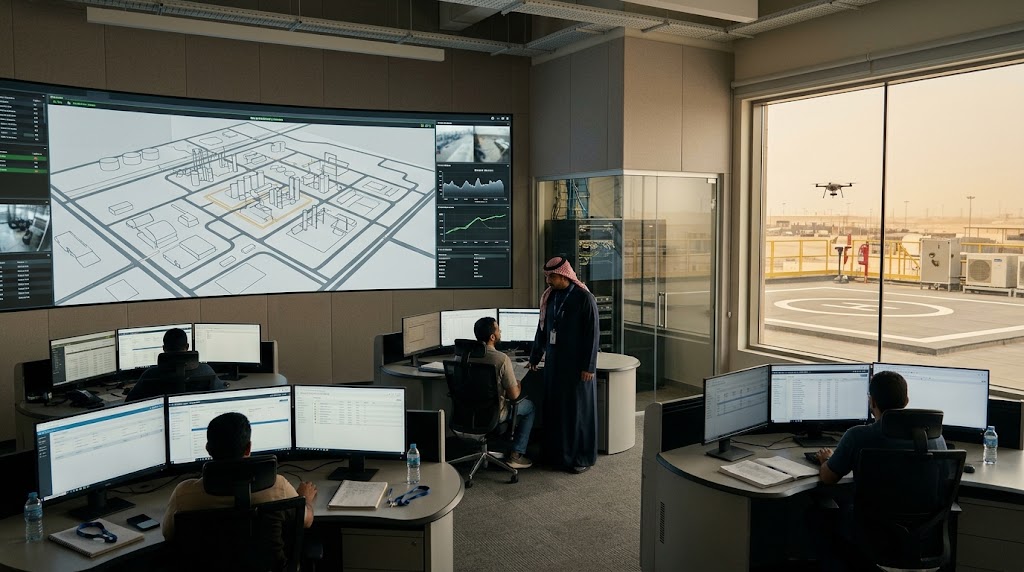
Saudi Facilities Security Forces has opened a command centre with seven specialised units connected to 13 regional command centres and supported by AI-equipped UAVs, but the public description does not establish autonomous enforcement by the drones.
Saudi Arabia has connected artificial-intelligence-equipped drones to a wider command architecture for protecting facilities.
The Facilities Security Forces has inaugurated a new command-and-control and security UAV centre in Riyadh.
The centre contains seven specialised units and is connected to 13 command-and-control centres at regional branches around the Kingdom.
That gives the announcement more operational substance than a standalone drone demonstration.
The drones sit inside a connected command system
The new centre uses integrated electronic platforms to receive reports, manage and monitor field operations and exchange security information.
It also coordinates with the National Center for Security Operations.
AI-equipped UAVs are used to support field surveillance within the Facilities Security Forces' areas of responsibility.
AI support is not the same as autonomous enforcement
The official announcement says AI technology supports surveillance and improves operational efficiency.
It does not say the drones independently determine violations, identify enforcement targets or carry out enforcement actions without human control.
Those would represent a materially different level of autonomy.
Thirteen regional centres can feed into one operational picture
Connecting regional command centres allows reports and field information to move through a common operational system.
The potential advantage is not only what an individual UAV can observe.
It is the ability to combine aerial information with reports, field operations and command coordination across several locations.
A cybersecurity centre was launched alongside it
The Interior Ministry also inaugurated a cybersecurity centre responsible for protecting data and information, securing networks and devices and monitoring technical systems for vulnerabilities and threats.
That matters because more connected field technology also creates more infrastructure that has to be protected.
Physical-security digitisation and cybersecurity increasingly become part of the same operating environment.
Personnel services are moving into the same digital transformation
Facilities Security Forces personnel also received new digital services through the Absher Interior application.
The wider technology upgrade includes integration between the Mawared system, Absher and the National Unified Access platform.
The programme therefore combines field operations, cybersecurity and internal administrative services rather than representing only a drone deployment.
Deployment scale beyond the command architecture is still unclear
The announcement gives a clear number for the seven specialised units and 13 connected regional centres.
It does not disclose the number of UAVs, flight hours, geographic coverage, AI models, detection accuracy or how frequently the systems are used in live operations.
Those figures would be necessary to measure the scale of the aerial layer itself.
What Arabian Current is watching
Watch fleet size, operating coverage, human oversight, measurable response-time improvements and whether Saudi authorities publish more detail about how AI-generated observations enter operational decisions.
The important distinction is between AI helping security teams see more and AI being permitted to decide what happens next.
Facilities Security Forces operated regional command structures and field-security operations using existing digital and operational systems.
A new central command-and-control and UAV system connects 13 regional centres and adds AI-equipped drones to field-surveillance support.
The next evidence should show UAV operating scale, coverage, measurable response improvements and how AI observations are governed inside operational decisions.
What supports the signal.
Claims stay source-linked, with limits recorded.
Saudi Press Agency confirms seven specialised units, links to 13 regional command centres, integration with security operations and the use of AI-equipped UAVs for field surveillance.
Operational use matters more than launch-day claims or model marketing.
Models, infrastructure, research and governance are separated when they imply different things.
The story is framed around what changes for Saudi Arabia organisations and decision-makers.
Open the evidence record.
1 linked sourceSupport + limitations recorded.
01Core evidenceInterior Minister Reviews Facilities Security Forces Operations, Inaugurates Centers for Command and UAV Systems, Cybersecurity
Saudi Press Agency
+
Interior Minister Reviews Facilities Security Forces Operations, Inaugurates Centers for Command and UAV Systems, Cybersecurity
Saudi Press Agency
Confirms the seven specialised units, 13 connected command centres, AI-equipped UAVs, cybersecurity centre and integrated digital systems.
Does not disclose UAV quantity, operating coverage, AI accuracy or autonomous decision-making authority.
Evidence is the next test.
Track UAV fleet size, operating hours, geographic coverage, human review, response metrics and additional technical governance disclosures.

Reporting with a visible evidence trail.
Arabian Current reporting is built around human editorial authority, source-linked claims and visible evidence trails.