
Qatar News Agency Is Training Government Personnel for Generative AI Search
Qatar News Agency has begun training its staff and personnel from government entities in website content management that explicitly includes both SEO and generative engine optimisation, or GEO. The course shows AI search visibility entering formal public-sector media training, but training for GEO does not guarantee placement inside AI-generated answers.
Arabian Current
Qatar News Agency is formally training its employees and personnel from government entities in GEO alongside SEO, signalling that visibility inside generative AI search is becoming part of public-sector content strategy.
Government communicators in Qatar are no longer being trained only to think about Google.
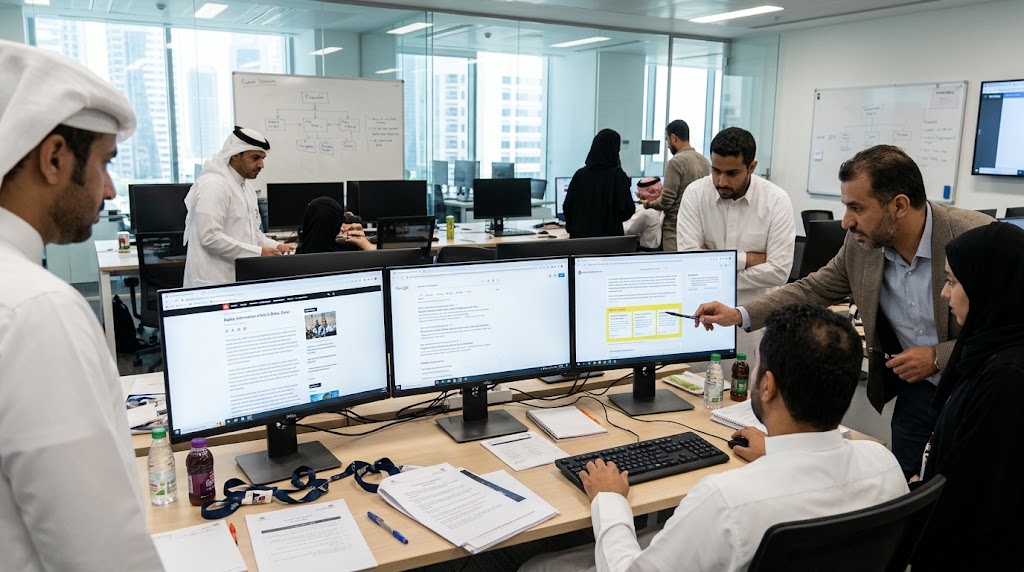
Qatar News Agency has started a three-day course on website content management and audience reach for agency employees and personnel from government entities.
The curriculum explicitly includes search engine optimisation and generative engine optimisation.
QNA describes GEO as improving visibility in generative AI search engines.
AI answers are becoming a distribution channel
Traditional SEO is designed around improving how content can be discovered through search-engine results.
Generative AI systems increasingly answer questions directly, often synthesising information from multiple sources rather than presenting a conventional list of links.
QNA's course acknowledges that public information now has to compete for visibility inside both environments.
The training extends beyond the news agency
Participants include QNA employees as well as personnel from government entities.
That makes the course more than an internal newsroom exercise.
It introduces AI-search discoverability into the skills being developed among a wider group of public-sector communicators.
GEO is not a guaranteed ranking system
Completing a training course does not mean a page will appear inside ChatGPT, Gemini, Copilot or another generative system.
Different systems use different retrieval, indexing, source-selection and answer-generation processes.
QNA's announcement establishes that GEO techniques are being taught. It does not publish measured gains in AI-search visibility resulting from those techniques.
Content quality is still part of the programme
The course is not described as only a traffic-optimisation exercise.
QNA says it also focuses on the quality of media content, analysis and how information is presented to readers and subscribers.
That matters because visibility without useful, credible source material does not necessarily make information more valuable once it reaches an audience.
Public information increasingly has two audiences
A government webpage can now be consumed directly by a person or indirectly through an AI system answering that person's question.
Those are different interfaces even when the underlying source material is identical.
For publishers and public institutions, that creates a new distribution question: how clearly can a machine identify what the page says, who published it and what evidence supports it?
The interesting metric comes after the course
QNA has not published baseline AI-search visibility, traffic from generative systems or before-and-after performance from the training.
Without those figures, the announcement establishes institutional interest in GEO rather than demonstrated performance.
Future measurement could show whether optimising public content for AI discovery actually changes reach.
What Arabian Current is watching
Watch whether Qatar government websites begin publishing more structured, source-rich and machine-readable information and whether agencies disclose referral or visibility data from generative AI systems.
The important change is already visible: being findable by AI is becoming part of the media job.
Government website audience development was primarily framed around traditional web publishing and search-engine optimisation.
QNA has explicitly included generative engine optimisation and visibility in generative AI search engines within a formal training course.
The useful next evidence would be measured changes in AI-search visibility, referral traffic or content practices across participating government entities.
What supports the signal.
Claims stay source-linked, with limits recorded.
QNA directly states that the training includes improving traditional search-engine optimisation and visibility in generative AI search engines through generative engine optimisation.
Operational use matters more than launch-day claims or model marketing.
Models, infrastructure, research and governance are separated when they imply different things.
The story is framed around what changes for Regional organisations and decision-makers.
Open the evidence record.
1 linked sourceSupport + limitations recorded.
01Core evidenceQNA Organizes Training Course on Website Content Management, Improving Audience Reach
Qatar News Agency
+
QNA Organizes Training Course on Website Content Management, Improving Audience Reach
Qatar News Agency
Confirms the three-day training course, participation by QNA staff and government personnel, and explicit inclusion of SEO and GEO for improving visibility in generative AI search engines.
Does not identify specific AI platforms, training techniques or measurable improvements in generative-search visibility.
Evidence is the next test.
Track government content structure, AI-search referrals, citations by generative systems, crawler accessibility and any published performance metrics following the training.

Reporting with a visible evidence trail.
Arabian Current reporting is built around human editorial authority, source-linked claims and visible evidence trails.