
UAE Law Firms Have New AI Principles. The Lawyer Still Owns the Answer
The UAE Ministry of Justice has launched ten guiding principles for law firms using artificial intelligence. The central rule is simple: AI-generated work must be reviewed and verified by humans, and lawyers remain responsible for its accuracy, suitability and impact on clients.
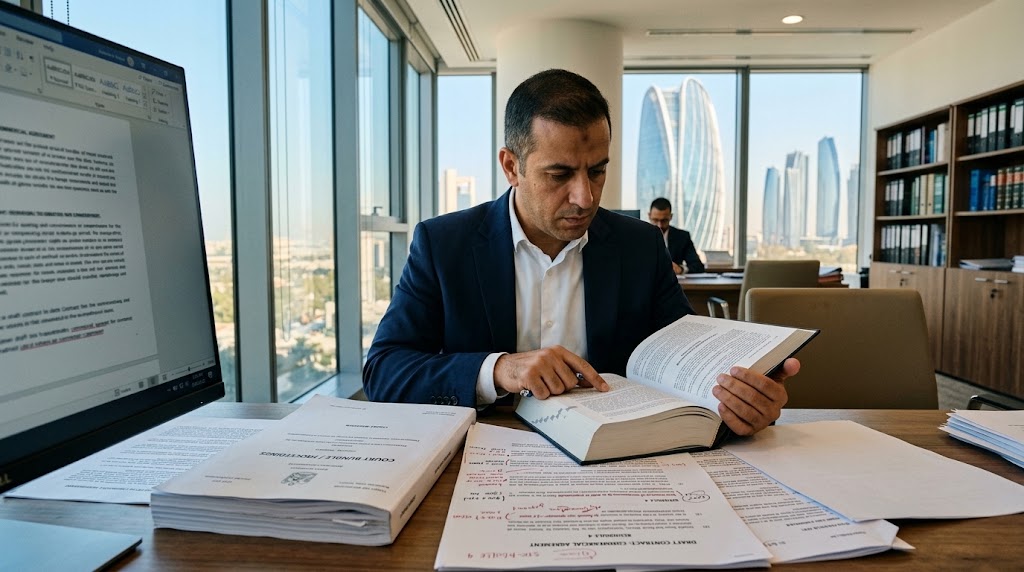
The UAE has issued ten guiding principles for law firms using AI, with human review, verification and professional responsibility remaining with lawyers.
Using artificial intelligence does not move professional responsibility from the lawyer to the software.
That is the clearest message in new UAE guiding principles for the use of AI systems by law firms.
The Ministry of Justice launched the initiative during the UN Crime Congress in Abu Dhabi.
It sets out ten core principles intended to guide law firms as AI becomes part of legal work.
Human review is not optional
Minister of Justice Abdullah Sultan bin Awad Al Nuaimi says AI-generated outputs must be subject to careful human review, verification and oversight.
Lawyers remain responsible for determining whether the output is accurate and suitable for use.
They must also consider its effect on the rights and interests of clients and other stakeholders.
The technology may assist the work. It does not inherit the professional responsibility.
The principles are guidance, not an AI lawyer licence
The initiative is described as guiding principles and a practical reference for UAE law firms.
The announcement does not create a new category of autonomous legal practitioner or say that AI systems can independently provide professional legal representation.
Existing duties around professional judgement, confidentiality and client protection remain central.
A plausible answer is not enough
Generative AI can produce text that reads confidently even when underlying information is incomplete or incorrect.
That is particularly sensitive in legal work because an error can affect a filing, contract, client decision or legal right.
The UAE principles therefore place verification with the professional using the system rather than with the tool itself.
Confidentiality remains part of the AI decision
The Ministry's announcement also stresses safeguarding confidentiality and protecting the rights of clients and other parties.
That makes tool selection part of professional judgement.
A lawyer has to consider not only whether an AI system can perform a task, but whether the information supplied to it can be handled appropriately.
The justice system itself is also experimenting with AI
The launch took place during a wider UN Crime Congress programme examining artificial intelligence, data analytics and digital technology across crime prevention and criminal justice.
Those discussions included AI in prosecution and law enforcement as well as risks created by criminal misuse of artificial intelligence.
The question is therefore no longer whether legal institutions will encounter AI.
It is where responsibility remains when they do.
What Arabian Current is watching
Watch whether the ten principles are followed by more detailed professional rules, disclosure requirements, court guidance or enforcement cases involving unverified AI-generated legal work.
The practical boundary is already clear: the machine may draft the answer, but the lawyer remains responsible for deciding whether that answer should leave the firm.
UAE legal professionals were increasingly adopting generative and analytical AI within existing professional and regulatory obligations.
The Ministry of Justice has introduced a dedicated set of guiding principles for responsible AI use by law firms.
The next evidence will be whether the principles lead to more detailed professional rules, court requirements or enforcement standards.
What supports the signal.
Claims stay source-linked, with limits recorded.
The Ministry of Justice announcement states that AI outputs require human review, verification and oversight and that lawyers remain responsible for accuracy, suitability and client impact.
Operational use matters more than launch-day claims or model marketing.
Models, infrastructure, research and governance are separated when they imply different things.
The story is framed around what changes for UAE organisations and decision-makers.
Open the evidence record.
2 linked sourcesSupport + limitations recorded.
01Core evidenceUAE Minister of Justice launches guiding principles for use of AI systems by law firms at UN Crime Congress
Emirates News Agency
+
UAE Minister of Justice launches guiding principles for use of AI systems by law firms at UN Crime Congress
Emirates News Agency
Confirms the ten principles, human review and verification requirements, lawyer responsibility, confidentiality considerations and intended role as a practical reference.
The announcement does not reproduce the complete detailed wording of all ten principles.
02ContextUN Crime Prevention Congress examines criminal justice development, digital transformation
Emirates News Agency
+
UN Crime Prevention Congress examines criminal justice development, digital transformation
Emirates News Agency
Provides context on the wider congress discussions around AI, criminal justice, human oversight, transparency and digital transformation.
Provides broader congress context rather than additional details of the law-firm principles themselves.
Evidence is the next test.
Track detailed publication of the ten principles, court guidance, client-disclosure expectations, confidentiality standards and cases involving AI-generated legal work.

Reporting with a visible evidence trail.
Arabian Current reporting is built around human editorial authority, source-linked claims and visible evidence trails.