
The UAE Says Every Deployed Federal AI Agent Must Plug Into a Control Tower
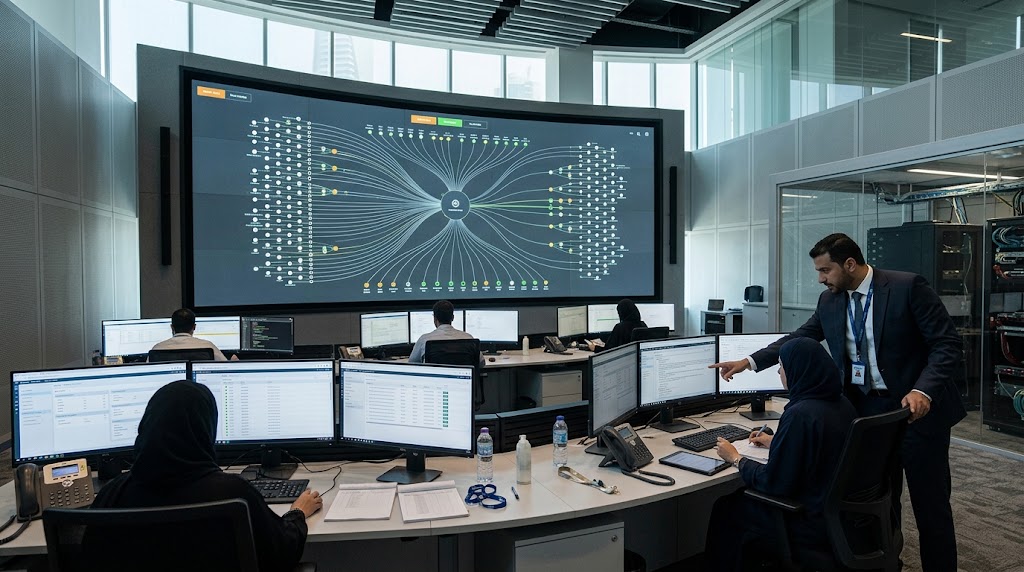
The UAE says it already operates an Agent Control Tower that every deployed federal AI agent must connect to, with both automated and human auditing. The disclosure adds a governance layer above the country's expanding FedAI ecosystem, although the government has not yet published detailed operating metrics or intervention rates.
Arabian Current
The UAE says every deployed federal AI agent must connect to an Agent Control Tower and be subject to both automated and human auditing, while broader FedAI deployment remains phased.
An AI agent acting for government creates a second question immediately after what it can do.
Who watches it?
The UAE says it now has an answer at federal level.
Omar Sultan Al Olama, Minister of State for Artificial Intelligence, says the country already operates an Agent Control Tower that every deployed AI agent must plug into.
The agents themselves are being audited
Al Olama said the UAE uses audits performed by agents as well as audits performed by humans.
That creates two layers of oversight rather than assuming an autonomous system can be trusted simply because it completed its task.
The exact architecture and intervention thresholds have not been publicly disclosed.
The control tower sits above a much larger federal AI system
The disclosure comes as the UAE continues developing FedAI, its national technical ecosystem for Agentic AI.
The Ministerial Council for Artificial Intelligence and Development said ministries and federal entities are being connected to the ecosystem under a phased action plan.
Multiple agents are also being developed across regulatory intelligence, strategic government work and other federal functions.
Deployment is phased, not universal
The government is not saying every federal process has already been handed to an autonomous agent.
The Ministerial Council described the next stage as a phased rollout in line with the project timeline.
That distinction matters because an ecosystem being ready to receive agents is different from every planned agent being live.
Monitoring does not transfer accountability to the machine
The wider discussion around the Control Tower focused explicitly on accountability.
The UAE's stated position is that autonomous systems should operate within proactive safety standards and institutional governance.
Another participant in the government session made the accountability principle clear: when an AI system harms a citizen, responsibility remains with the institution that deployed it rather than the AI itself.
Human life and livelihood are the stated red line
Al Olama said the UAE does not evaluate AI deployment only through productivity or financial savings.
He described decisions affecting human life and livelihood as a red line.
That matters because agentic systems are increasingly capable of completing multi-step actions rather than merely producing recommendations.
The potential consequence of an error therefore rises as the agent gains permission to act.
A control tower is useful only if it can stop something
Central visibility into agent activity can create an audit trail.
The harder governance question is what happens when the monitoring system detects unusual, incorrect or harmful behaviour.
Public disclosures so far do not define intervention thresholds, rollback mechanisms, incident statistics or how quickly an agent can be suspended.
Those operational details will determine whether the Control Tower is primarily observational or actively protective.
The UAE is making AI governance infrastructure part of deployment
Many AI governance debates begin after organisations have already deployed autonomous tools.
The UAE's current architecture suggests monitoring is being built into the federal agent ecosystem itself.
That is a different model from treating each ministry's agent as an isolated software application.
What Arabian Current is watching
Watch how many agents connect to the Control Tower, what actions are logged, how human intervention works, whether agents can be stopped centrally and whether the government publishes incident or performance indicators.
The important metric will not be how many agents exist. It will be whether the oversight layer can explain and control what those agents actually do.
The UAE had announced FedAI and multiple federal Agentic AI projects while details of the central oversight architecture remained limited.
The government has publicly disclosed that an Agent Control Tower already exists and that every deployed agent is required to connect to it.
The next evidence should show how monitoring, intervention, rollback and human accountability work in live government operations.
What supports the signal.
Claims stay source-linked, with limits recorded.
WAM quotes the UAE Minister of State for AI directly saying every deployed agent must plug into the Agent Control Tower and that audits are performed by agents and humans. A Ministerial Council update separately confirms ministries are being connected to FedAI and agents will roll out in phases.
Operational use matters more than launch-day claims or model marketing.
Models, infrastructure, research and governance are separated when they imply different things.
The story is framed around what changes for UAE organisations and decision-makers.
Open the evidence record.
2 linked sourcesSupport + limitations recorded.
01Core evidenceThe currency of the future is trust: UAE is building controls to earn it
Emirates News Agency
+
The currency of the future is trust: UAE is building controls to earn it
Emirates News Agency
Directly quotes the UAE Minister of State for AI describing the Agent Control Tower, mandatory connection of deployed agents and dual agent and human auditing.
Does not disclose the technical architecture, agent count, intervention thresholds or audit results.
02Core evidenceMinisterial Council for Artificial Intelligence and Development reviews progress on FedAI
Emirates News Agency
+
Ministerial Council for Artificial Intelligence and Development reviews progress on FedAI
Emirates News Agency
Confirms FedAI, ministry and federal-entity connectivity, phased agent rollout and development of agents for regulatory intelligence and strategic government work.
Does not identify every agent already deployed or provide operational performance data.
Evidence is the next test.
Track connected agent numbers, audit architecture, permission controls, intervention rates, incident reporting and public performance metrics.

Reporting with a visible evidence trail.
Arabian Current reporting is built around human editorial authority, source-linked claims and visible evidence trails.