
Talabat's Dubai Robot Pilot Moves Autonomous Delivery Inside the Building
A live pilot at Dubai Digital Park hands orders from riders to robots that use elevators and complete doorstep delivery. The harder Physical AI problem is not road autonomy but building access.
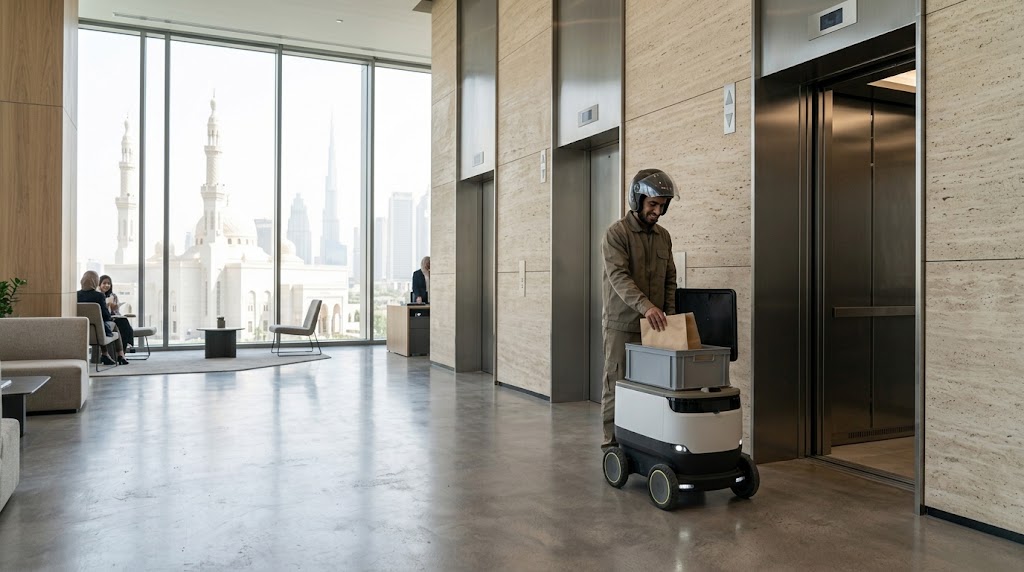
Talabat and QuikBot have demonstrated a live high-rise delivery handoff in Dubai where a robot takes over inside the building, uses the elevator and completes doorstep delivery.
The difficult part of autonomous delivery in a vertical city may begin after the vehicle reaches the building.
Talabat and QuikBot have completed a live pilot at Dubai Digital Park in Dubai Silicon Oasis in which a delivery rider hands an order to a robot at a designated point inside the building. The robot then uses the elevator and completes the trip to the customer's door.
That makes the experiment more interesting than a conventional sidewalk-delivery demo. The robot has to move through infrastructure designed for people, including controlled access, elevators, corridors and a final secure handoff.
The rider stops at the building, not the customer's door
Talabat describes the workflow simply: rider to robot to doorstep. The company says the pilot is intended to explore whether robotics can reduce the time riders spend completing high-rise deliveries.
QuikBot says the pilot is live at the A6 commercial building in Dubai Digital Park. Its description adds that customers retrieve the order using a one-time password after the robot reaches the door.
Khaleej Times reported that the system is aimed at the part of a high-rise delivery that can absorb extra time, including entering the building and waiting for elevators.
The building becomes part of the autonomy stack
A road robot can navigate a pavement without needing permission from an elevator. An indoor delivery robot cannot.
For this model to work at scale, the robot needs some way to identify itself, receive access, call or use lifts and move through building systems without creating a new manual process at every door.
QuikBot describes its own platform as providing that layer of identity and building interaction. Those are company claims rather than independently benchmarked performance, but they point to the real infrastructure problem behind high-rise Physical AI.
The pilot does not yet prove city-scale economics
Neither Talabat nor the independent reporting reviewed for this article provides fleet size, delivery-completion rates, intervention frequency, cost per delivery or a timetable for wider deployment.
QuikBot has also published estimates about rider time returned by its workflows. Those figures are useful as a company benchmark but should not be treated as independently verified operating results.
What the Dubai test does establish is narrower: a live handoff-and-elevator workflow has been demonstrated inside a commercial building, and Talabat has signed an agreement with QuikBot to keep exploring the model.
Physical AI is becoming an infrastructure question
The next phase of delivery automation will not be decided by robot hardware alone. Buildings, access systems, elevators, identity, security and customer handoff all have to cooperate.
That is why this pilot belongs in the Experiential Technology desk. The technology changes how a person experiences a physical place, but the enabling layer is mostly invisible: the building itself has to become machine-readable and machine-accessible.
The next evidence to watch is expansion beyond a single commercial building and whether the model produces measurable gains without adding new friction for building operators, customers or riders.
A rider normally carries the delivery through the building, including lobby access, elevator waiting and corridor travel.
At Dubai Digital Park's A6 building, the pilot allows the rider to hand the order to a robot that completes the indoor journey.
Watch for expansion beyond one building, measurable rider-time savings, reliability data and deeper integration with building access and elevator systems.
Show the record behind the claim.
Claims stay source-linked, with limits recorded.
Talabat confirms the MoU and completed live pilot. QuikBot provides operational detail on the A6 workflow and OTP handoff, while Khaleej Times independently reports the high-rise delivery test. Public evidence does not yet establish fleet economics or city-scale performance.
Material reporting is designed to retain the evidence behind the published claim.
Companies, regulators and projects can link back to persistent records.
Automation can assist discovery and extraction; publication authority remains editorial.
Open the evidence record.
3 linked sourcesSupport + limitations recorded.
01Core evidencetalabat x QuikBot autonomous delivery pilot
talabat
+
talabat x QuikBot autonomous delivery pilot
talabat
Confirms the MoU, completed live pilot at Dubai Digital Park and rider-to-robot-to-door workflow using elevators.
Company post; it does not disclose fleet size, reliability, economics or independently verified time savings.
02Core evidenceQUIKBOT x talabat: autonomous delivery from road to door
QuikBot
+
QUIKBOT x talabat: autonomous delivery from road to door
QuikBot
Identifies the A6 commercial building, describes elevator navigation and OTP retrieval, and explains QuikBot's building-integration model.
Vendor description; claims about platform uniqueness and productivity gains are not independently validated.
03Supporting evidenceDelivery robots for Dubai high-rise buildings tested by Talabat
Khaleej Times
+
Delivery robots for Dubai high-rise buildings tested by Talabat
Khaleej Times
Independently reports the pilot location and the workflow in which the robot takes over the building portion of the delivery.
Does not provide independent performance testing, economics or long-term deployment commitments.
The story keeps moving.
Additional buildings, fleet size, intervention rates, delivery-completion data, rider-time measurements and formal integrations with property and elevator systems.

Reporting with a visible evidence trail.
Arabian Current reporting is built around human editorial authority, source-linked claims and visible evidence trails.