
Emirates Showed 60+ Tech Projects at ForsaTEK. They Are Not All Live Deployments
Emirates Group showcased more than 60 technology projects at ForsaTEK 2026, spanning AI, robotics and human-machine collaboration. But the projects sit at different stages, from early concepts and proofs of concept to systems already being used inside the group.
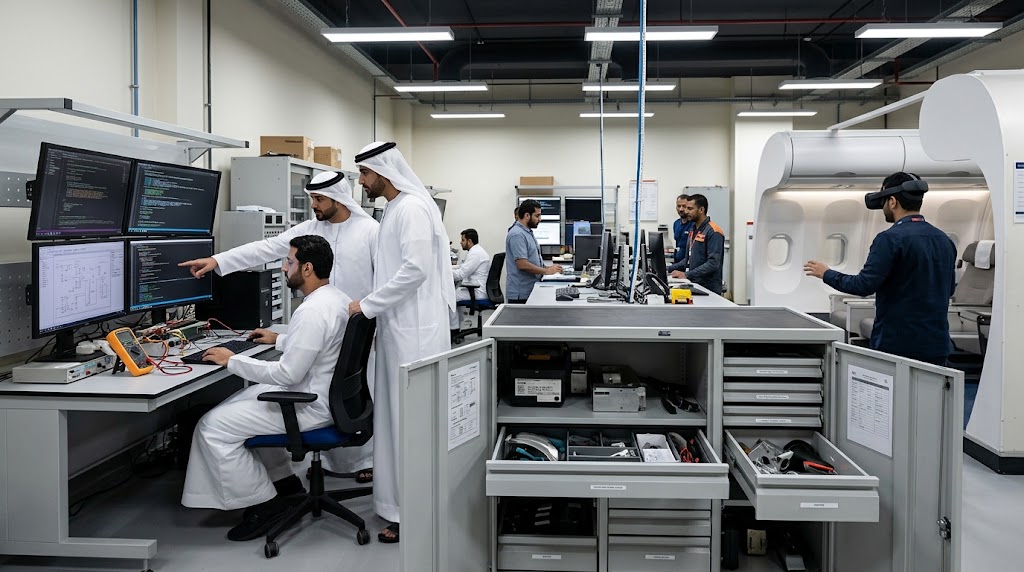
Emirates Group showcased more than 60 technology projects at ForsaTEK 2026, but they range from research and proofs of concept to systems already in operational use.
Emirates Group has put more than 60 technology projects on display across artificial intelligence, robotics and human-machine collaboration.
The number sounds like a large AI deployment programme.
It is more useful to read it as an innovation pipeline.
Emirates says the projects showcased at ForsaTEK 2026 sit at different stages, ranging from research and early concepts to technology already being used in operations.
Showcased does not mean deployed
ForsaTEK is designed partly as a testing ground for emerging technology.
That means a project appearing at the event is not evidence that it has been rolled out across Emirates Group.
Some technologies are being explored, some are being tested through proofs of concept and others have already crossed into operational use.
The stage matters more than the project count alone.
ARRIVE is one of the more mature deployments
Emirates highlighted ARRIVE, an internally developed framework for agentic software engineering.
The system is designed to let development teams use AI-assisted engineering while preserving records of intent, scope, risk, evidence and human decision-making.
By the end of August 2026, Emirates says more than 2,000 IT employees had been onboarded through its AI Gateway.
That gives ARRIVE a different evidence status from an early-stage demonstration.
AI is moving into employee workflows
Emirates is also expanding secure employee access to advanced AI models and conversational tools through its wider collaboration with OpenAI.
The stated aim is to help employees handle complex tasks, improve productivity and support collaboration across functions.
The useful next question is how widely those tools are actually used and what measurable operating changes follow.
Not everything at ForsaTEK was an AI chatbot
The showcase also included virtual-reality training tools for cabin crew, the One Device crew ecosystem and dnata Technical Services' Smart Hub.
The Smart Hub is described as a fully automated inventory-management system providing round-the-clock access to maintenance materials.
Emirates says it also replaces disposable aerosol containers with reusable bulk systems, avoiding an estimated 3,600 contaminated cans entering the waste stream annually.
Seven startups are still working through proofs of concept
Intelak, the travel and tourism incubator operated with Dubai's Department of Economy and Tourism, showcased seven startups.
Those companies will continue working with Intelak and DET on proofs of concept.
That wording is important.
A proof of concept tests whether an idea can work in a real environment. It is not the same thing as a commercial deployment or procurement contract.
What Arabian Current is watching
Watch which ForsaTEK projects move from demonstration into daily operations, how employee AI usage develops and whether Intelak proofs of concept convert into commercial deployments.
The most useful future metric will not be how many technologies Emirates can showcase. It will be how many survive the transition into measurable operational use.
Emirates had been testing and introducing AI, automation and digital tools across different parts of its aviation operations.
ForsaTEK provides a view of a pipeline exceeding 60 projects, while mature initiatives such as ARRIVE have already reached thousands of employees.
The meaningful next evidence will be which projects move from demonstrations and proofs of concept into scaled operational use.
What supports the signal.
Claims stay source-linked, with limits recorded.
Emirates directly states that ForsaTEK projects span different stages of development. It also reports more than 2,000 IT employees onboarded through the AI Gateway by the end of August and identifies several technologies already in use.
Operational use matters more than launch-day claims or model marketing.
Models, infrastructure, research and governance are separated when they imply different things.
The story is framed around what changes for UAE organisations and decision-makers.
Open the evidence record.
2 linked sourcesSupport + limitations recorded.
01Core evidenceCatalysing the next wave of innovation at the Emirates Group: ForsaTEK 2026 concludes successfully
Emirates Group
+
Catalysing the next wave of innovation at the Emirates Group: ForsaTEK 2026 concludes successfully
Emirates Group
Confirms more than 60 technology projects, their differing development stages, ARRIVE adoption, Smart Hub operations and seven Intelak startups continuing with proofs of concept.
Emirates does not disclose the deployment status, cost or measurable impact of every project shown at ForsaTEK.
02ContextEmirates Group concludes ForsaTEK 2026 with advanced AI solutions
Emirates News Agency
+
Emirates Group concludes ForsaTEK 2026 with advanced AI solutions
Emirates News Agency
Provides independent public reporting on the ForsaTEK showcase, the 60-plus projects, ARRIVE and the group's wider AI programme.
The report relies materially on information provided by Emirates Group about its internal systems.
Evidence is the next test.
Track scaled deployment, employee adoption, operational savings, startup proof-of-concept conversions and measurable customer or productivity outcomes.
Reporting with a visible evidence trail.
Arabian Current reporting is built around human editorial authority, source-linked claims and visible evidence trails.