
Ceer's EXOBOT Reveal Moves Saudi EV Ambition From Factory Buildout to Product
Saudi Arabia's homegrown automotive project has moved from factory construction and supplier agreements to its first visible products. The harder test now is manufacturing scale, delivery and whether a domestic EV ecosystem forms around them
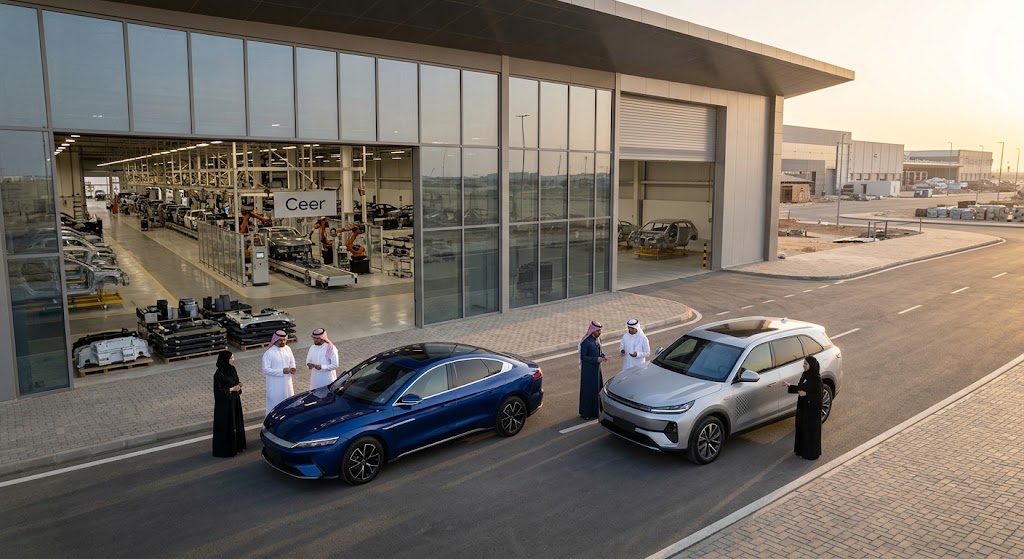
Ceer's first vehicle reveal shifts Saudi Arabia's EV project from industrial preparation toward product execution, but the decisive evidence will be repeatable local manufacturing and customer delivery.
Saudi Arabia's electric-vehicle strategy now has something it did not have before: a finished product to put in front of customers.
Ceer revealed its first flagship vehicles, the EXOBOT sedan and SUV, on September 21. The company says the two models will be manufactured at its industrial complex in King Abdullah Economic City and form the first part of a seven-model portfolio planned over the next five years.
The milestone is bigger than a vehicle reveal
Ceer was launched in 2022 as a joint venture between the Public Investment Fund and Foxconn, with licensed component technology from BMW. For most of the period since then, the story has been about factory construction, supplier localisation, engineering capability and whether Saudi Arabia could assemble the industrial stack required for a domestic automotive manufacturer.
The EXOBOT reveal moves that story one stage forward. Ceer is no longer only a planned manufacturing platform. It now has named vehicles, visible product design and a portfolio roadmap.
That still leaves a large gap between unveiling a car and manufacturing it repeatedly at commercial quality and volume.
The factory is the real product
Ceer's industrial complex is intended to include the press, body, paint and general-assembly operations required for vehicle production. PIF has previously described the project as part of a wider Saudi automotive ecosystem that also includes component suppliers and other mobility investments.
That makes the factory more consequential than the EXOBOT styling itself.
If Ceer can move from reveal to repeatable local production, Saudi Arabia gains manufacturing capability, supplier demand, engineering jobs and an anchor customer for an automotive cluster. If it cannot, the vehicle reveal remains branding rather than industrial evidence.
The economic projections remain projections
PIF says Ceer is expected by 2034 to contribute more than SAR30 billion to Saudi GDP and improve the trade balance by around SAR80 billion.
Those figures describe the intended economic effect of the company. They are not current realised contributions, and the September launch does not by itself establish future production volume, export demand or supplier localisation.
The useful measurements now become much more concrete: production start, units built, customer deliveries, local content and the number of suppliers physically operating around the manufacturing cluster.
What Arabian Current is watching
Watch the transition from vehicle reveal to serial production: confirmed manufacturing dates, customer deliveries, local supplier activity, production volume and whether the remaining five planned models arrive on schedule.
Ceer existed primarily as a factory, supplier and engineering buildout around a planned Saudi EV brand.
The company has revealed its first named vehicles, the EXOBOT sedan and SUV, within a planned seven-model portfolio.
The next test is serial production: manufacturing start, deliveries, local-content growth and whether the wider supplier ecosystem develops around the plant.
What supports the signal.
Claims stay source-linked, with limits recorded.
PIF establishes the EXOBOT launch, vehicle roadmap and manufacturing location. Earlier PIF records establish Ceer's ownership structure and factory strategy. Economic contribution figures remain forward projections rather than realised results.
Operational use matters more than launch-day claims or model marketing.
Models, infrastructure, research and governance are separated when they imply different things.
The story is framed around what changes for Saudi Arabia organisations and decision-makers.
Open the evidence record.
3 linked sourcesSupport + limitations recorded.
01Core evidenceHRH the Crown Prince Launches CEER's Flagship Vehicles Further Strengthening Saudi Arabia's Position in the Global Automotive Industry
Public Investment Fund
+
HRH the Crown Prince Launches CEER's Flagship Vehicles Further Strengthening Saudi Arabia's Position in the Global Automotive Industry
Public Investment Fund
Confirms the EXOBOT sedan and SUV reveal, the planned seven-model portfolio, manufacturing at Ceer's King Abdullah Economic City facility and PIF's stated 2034 economic projections.
Does not establish realised production volumes, customer demand, deliveries or achievement of the projected GDP and trade-balance contribution.
02ContextHRH Crown Prince launches Ceer, the first Saudi electric vehicle brand
Public Investment Fund
+
HRH Crown Prince launches Ceer, the first Saudi electric vehicle brand
Public Investment Fund
Establishes Ceer's 2022 creation as a PIF-Foxconn joint venture, its BMW component-technology relationship and original manufacturing mandate.
The original launch contained forward-looking production and economic expectations and does not establish subsequent commercial performance.
03Supporting evidenceCeer awards construction contract to build its electric car complex in Saudi Arabia
Public Investment Fund
+
Ceer awards construction contract to build its electric car complex in Saudi Arabia
Public Investment Fund
Describes the production complex, including press, body, paint and general-assembly operations, supporting the distinction between product reveal and industrial manufacturing execution.
Factory construction plans do not establish completed capacity utilisation or current production output.
Evidence is the next test.
Track production start, customer delivery dates, annual output, supplier localisation and launches of the remaining planned models.

Reporting with a visible evidence trail.
Arabian Current reporting is built around human editorial authority, source-linked claims and visible evidence trails.