
Bahri Has Nine Ships on Order in Saudi Arabia. The Three New VLCCs Arrive From 2029
Bahri has signed a SAR1.692 billion contract with International Maritime Industries to build three 320,000-DWT crude carriers in Saudi Arabia, bringing its locally contracted 2026 orderbook to nine vessels. The three VLCCs are scheduled for phased delivery between 2029 and 2030.
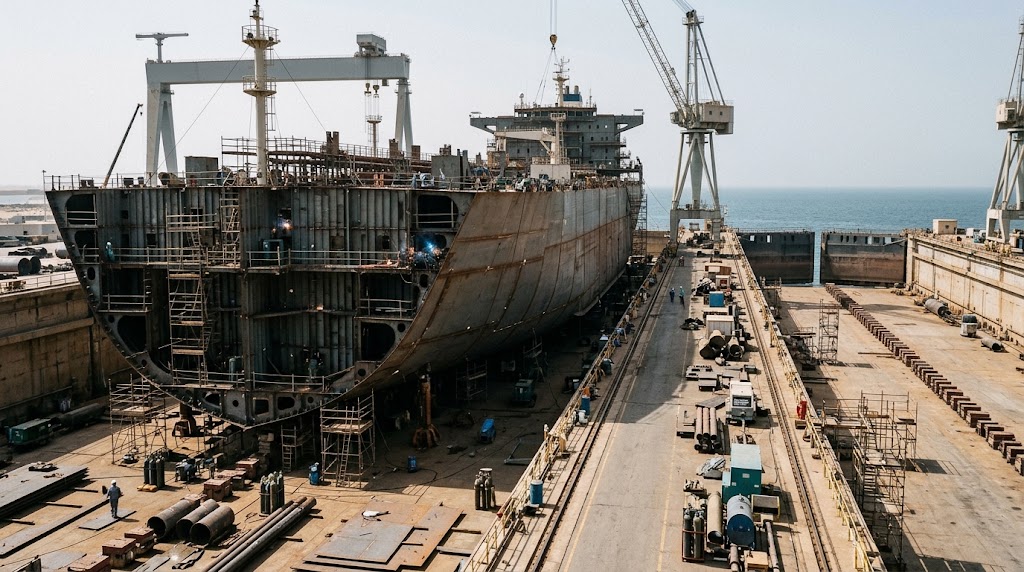
Arabian Current
What happened
Three VLCCs have been added under a SAR1.692 billion contract, increasing Bahri's Saudi shipbuilding orderbook to nine vessels.
Why it matters
Bahri has contracted IMI to build three 320,000-DWT VLCCs in Saudi Arabia for approximately SAR1.692 billion, bringing its Saudi-built 2026 orderbook to nine vessels, but delivery of the new tankers begins only from 2029.
The disclosures do not provide a component-level Saudi local-content percentage or a complete construction schedule for each individual vessel.
Bahri has contracted IMI to build three 320,000-DWT VLCCs in Saudi Arabia for approximately SAR1.692 billion, bringing its Saudi-built 2026 orderbook to nine vessels, but delivery of the new tankers begins only from 2029.
Saudi Arabia's shipbuilding localisation effort now has three very large oil tankers attached to a signed commercial contract.
Bahri and International Maritime Industries have agreed on the construction of three Very Large Crude Carriers at IMI's Saudi facility for approximately SAR1.692 billion.
Each vessel will have a deadweight capacity of 320,000 tonnes.
The contract is real today. The ships are not.
Delivery is scheduled between 2029 and 2030
IMI is expected to deliver the three vessels in phases between 2029 and 2030.
Until then, the agreement represents contracted future shipbuilding work rather than additional operating capacity inside Bahri's current fleet.
That distinction matters when measuring how quickly Saudi maritime localisation is converting into physical vessels.
Bahri now has nine vessels contracted for construction in Saudi Arabia
Bahri says the latest order brings the number of vessels it has contracted to be built in the Kingdom since the beginning of 2026 to nine.
That includes six Ultramax bulk carriers and the three new VLCCs.
The orderbook therefore provides a broader measure of domestic shipbuilding demand than the three-tanker contract on its own.
These are large crude carriers, not small localisation projects
At 320,000 deadweight tonnes each, the vessels sit in the Very Large Crude Carrier category used for moving substantial oil cargoes over long international routes.
Bahri says the vessels will include advanced energy-efficiency technology as part of its fleet-modernisation strategy.
The contract therefore combines domestic manufacturing policy with replacement and expansion of commercial shipping capacity.
IMI's headline annual capacity is also a future operating state
Saudi Press Agency says that once IMI's Ras Al-Khair shipyard is fully operational, it will be capable of building more than 40 vessels and six offshore drilling rigs annually.
It will also be able to provide maintenance and repair services for as many as 250 vessels and 15 drilling rigs each year.
Those figures describe the shipyard's intended full operating capability rather than evidence that all of that annual capacity is already being achieved today.
A domestic orderbook matters before the yard reaches full scale
Large industrial facilities need predictable demand as well as physical infrastructure.
Orders from Bahri create contracted work that can support supplier development, workforce planning and the wider maritime supply chain while IMI scales its operations.
That makes the nine-vessel Saudi orderbook an important industrial indicator even before the ships are delivered.
Local construction does not mean every component will be Saudi-made
Building the vessels at IMI establishes the location of final ship construction.
The announcements do not provide a component-by-component local-content breakdown.
Engines, specialist systems, steel, electronics and other equipment may involve domestic and international suppliers.
The depth of localisation should therefore be measured separately from the physical location of the shipyard.
What Arabian Current is watching
Watch construction milestones, local supplier participation, workforce growth, launch dates and the first commercial voyages after delivery.
The next meaningful state change is when Saudi-built VLCCs move from contract documents into the water.
Bahri had already placed orders for six Ultramax bulk carriers to be built domestically.
Three VLCCs have been added under a SAR1.692 billion contract, increasing Bahri's Saudi shipbuilding orderbook to nine vessels.
The next evidence will be construction milestones followed by phased delivery of the VLCCs between 2029 and 2030.
Show the record behind the claim.
Claims stay source-linked, with limits recorded.
SPA and Bahri directly confirm the three-vessel contract, 320,000-DWT specification, SAR1.692 billion approximate value and 2029-2030 delivery window. Bahri says the order brings its number of vessels contracted for Saudi construction in 2026 to nine.
Material reporting is designed to retain the evidence behind the published claim.
Companies, regulators and projects can link back to persistent records.
Automation can assist discovery and extraction; publication authority remains editorial.
Open the evidence record.
2 linked sourcesSupport + limitations recorded.
01Core evidenceIMI Signs Contract to Build Three Very Large Crude Carriers Worth Approximately SAR1.692 Billion
Saudi Press Agency
+
IMI Signs Contract to Build Three Very Large Crude Carriers Worth Approximately SAR1.692 Billion
Saudi Press Agency
Confirms the three VLCCs, contract value, vessel capacity, energy-efficiency technology and delivery period from 2029 to 2030.
Does not provide a component-level breakdown of Saudi local content or individual vessel construction milestones.
02Core evidenceBahri and IMI Sign SAR 1.692 Billion Contract for Three Newbuild VLCCs
Bahri
+
Bahri and IMI Sign SAR 1.692 Billion Contract for Three Newbuild VLCCs
Bahri
Confirms the contract and states that the latest order brings the number of Bahri vessels contracted for construction in Saudi Arabia during 2026 to nine.
Company disclosure does not independently verify future construction or delivery performance.
The story keeps moving.
Track keel laying, launch milestones, local-content participation, suppliers, delivery dates and entry into Bahri commercial operations.

Reporting with a visible evidence trail.
Arabian Current reporting is built around human editorial authority, source-linked claims and visible evidence trails.