
The UAE Is Turning AI Wearables Into a Developer Testbed
Meta, the UAE Cyber Security Council and Startupbootcamp are putting AI glasses into the hands of developers, students and startups. The more useful signal is that security and privacy are being pushed into the build process from day one.
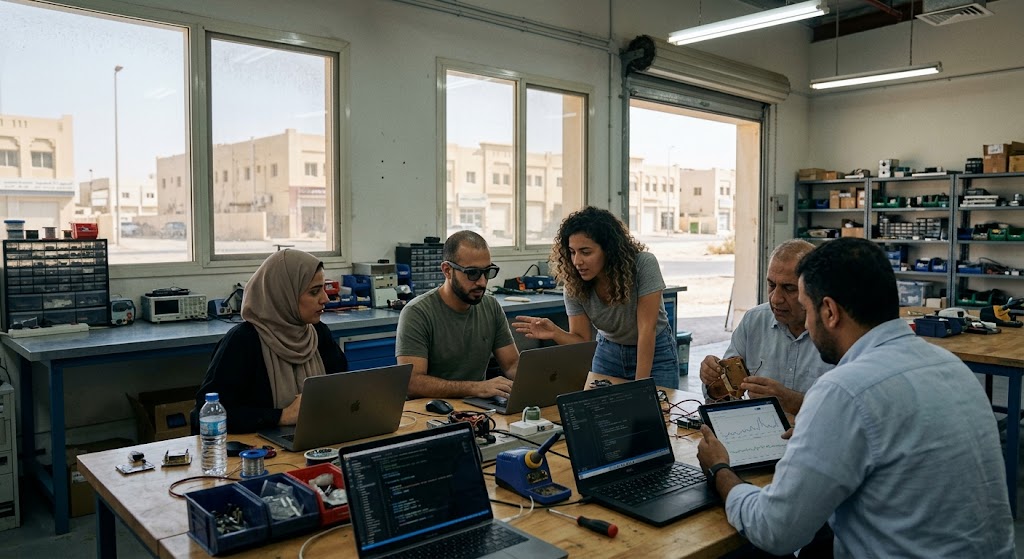
Wearables Studio UAE moves AI experimentation into physical-world interfaces while bringing cybersecurity and privacy into the development process before products reach deployment.
The UAE is giving developers a new place to test what happens when AI leaves the screen.
Meta, the UAE Cyber Security Council and Startupbootcamp announced Wearables Studio UAE on September 21, a programme focused on building AI-powered applications for wearable devices. It is aimed at students, developers, entrepreneurs and startups, with technical support, mentoring and practical build activity around wearable platforms.
The important shift is the interface
Most recent Gulf AI programmes have focused on models, cloud infrastructure, government systems and enterprise deployment. Wearables move the problem somewhere different: AI begins interacting with what a user sees, hears and does in the physical world.
That changes the engineering constraints. A wearable experience cannot assume the user is sitting in front of a dashboard. Camera input, voice, context, latency and hands-free interaction become part of the product itself.
Meta has already opened parts of its wearable platform to third-party developers through its Wearables Device Access Toolkit. The company has highlighted applications that use its glasses for accessibility, object understanding and hands-free assistance.
Cybersecurity is being inserted before the demo
The UAE Cyber Security Council's role is what makes the programme more interesting than a normal hardware hackathon.
AI glasses can process camera, microphone and contextual data involving both the wearer and people around them. That makes privacy and security design part of the product architecture rather than a compliance question that can be postponed until launch.
Wearables Studio was announced around GISEC Global 2026, where AI, IoT, immersive technology and cybersecurity are increasingly being treated as overlapping systems rather than separate technology categories.
A testbed is not a deployment
The programme does not yet prove that UAE-built wearable applications will become production systems.
A build sprint can show that developers can use the hardware and tooling. It cannot establish that hospitals, retailers, schools, tourism operators or other organisations will adopt the resulting applications at scale.
The useful evidence comes next: functioning pilots, repeat users and organisations choosing to keep the applications running after the programme ends.
What Arabian Current is watching
Watch which teams reach real-world pilots, whether Arabic-first wearable experiences emerge, how privacy controls operate outside a controlled workshop and whether any projects gain users beyond the final showcase.
Most visible UAE AI programmes were centred on models, software, infrastructure and institutional adoption.
Developers, students and startups are being given a dedicated programme for building AI-powered wearable applications with technical and cybersecurity support.
The real test is whether projects move from workshops and showcases into named pilots, recurring users and production deployments.
Show the record behind the claim.
Claims stay source-linked, with limits recorded.
The launch, partners and programme purpose are established by the UAE announcement. Meta sources provide product and developer-tool context. None of the sources establish successful UAE production deployments yet.
Material reporting is designed to retain the evidence behind the published claim.
Companies, regulators and projects can link back to persistent records.
Automation can assist discovery and extraction; publication authority remains editorial.
Open the evidence record.
3 linked sourcesSupport + limitations recorded.
01Core evidenceUAE Cyber Security Council, Meta launch first-of-its-kind Wearables Studio UAE
Emirates News Agency
+
UAE Cyber Security Council, Meta launch first-of-its-kind Wearables Studio UAE
Emirates News Agency
Confirms the launch of Wearables Studio UAE, the partnership involving Meta, the UAE Cyber Security Council and Startupbootcamp, and the programme's focus on AI-powered wearable applications and developer talent.
Does not prove that any participant has reached a production deployment, sustained adoption or commercial scale.
02ContextOur AI Wearables Are Changing the Game for Disabled People
Meta
+
Our AI Wearables Are Changing the Game for Disabled People
Meta
Confirms that Meta provides a Wearables Device Access Toolkit for third-party developers and describes hands-free AI-glasses use cases.
Does not establish that these existing use cases are part of Wearables Studio UAE or that UAE developers will reproduce the same outcomes.
03ContextGISEC GLOBAL 2026
GISEC Global
+
GISEC GLOBAL 2026
GISEC Global
Provides the event context in which the programme was unveiled and shows GISEC's focus on cybersecurity, AI, IoT and immersive technology.
Does not independently validate the performance or adoption of Wearables Studio projects.
The story keeps moving.
Watch for participating teams, named pilots, Arabic-first applications, privacy and security controls in real environments, and organisations adopting projects after the programme ends.

Reporting with a visible evidence trail.
Arabian Current reporting is built around human editorial authority, source-linked claims and visible evidence trails.