
Dubai Built 248 Test Scenarios for Autonomous Vehicles. The Lab Is Not a Public Rollout
Dubai Mobility Labs has opened at Dubai Silicon Oasis with 248 scenarios for testing autonomous and future mobility systems. Vehicles from companies including WeRide, Pony.ai and Tesla have already been tested there, but a proving ground is a step toward deployment, not evidence that every tested technology is approved for public service.
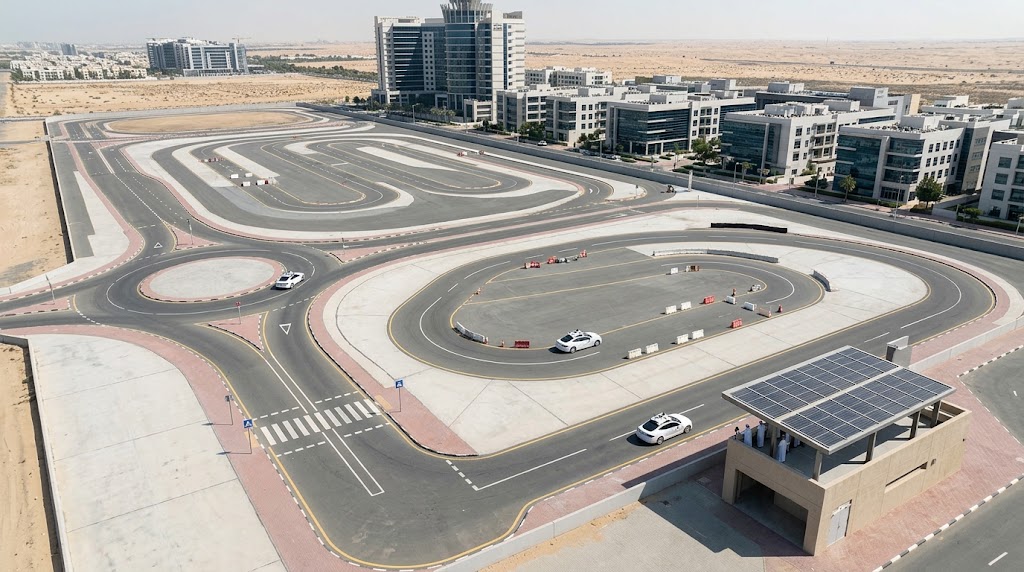
Dubai Mobility Labs has opened with 248 scenarios for autonomous and future mobility testing, providing infrastructure that can move technologies toward deployment without implying that every tested vehicle is approved for commercial public use.
Dubai has built a place where autonomous vehicles can encounter difficult traffic situations before ordinary road users have to encounter the consequences.
Dubai Mobility Labs has opened at Dubai Silicon Oasis as a testing, validation and certification environment for autonomous and future mobility technologies.
The facility supports 248 test scenarios across controlled environments and public-road testing routes.
The important part is what happens between a successful test and a commercial service.
The test environment is designed to create things that can go wrong
The scenarios cover urban traffic situations that allow engineers to assess vehicle sensing, decision-making, interaction with other road users and responses to changing surrounding conditions.
The multi-purpose testing area supports 195 scenarios by itself.
RTA says 143 were built into the core design and another 52 were added through later enhancements.
The purpose is to find weaknesses before a vehicle progresses toward wider road operation.
The testing does not stay entirely behind a fence
Dubai Mobility Labs combines controlled proving-ground environments with public-road testing routes extending toward Al Qudra.
That creates a progression from repeatable simulated conditions into more realistic road environments.
It also allows developers to test how systems behave when conditions become less predictable.
Several major autonomous-vehicle companies have already used it
RTA and Emirates News Agency say technologies and vehicles from companies including WeRide, Pony.ai and Tesla have already undergone trials through the testing environment.
That shows the facility is not simply infrastructure waiting for its first user.
But participation in testing should not be interpreted as approval for commercial passenger operations.
DEKRA gets the first three years
RTA has appointed testing and certification company DEKRA to operate Dubai Mobility Labs during its first three years.
Its role includes managing testing activities and facilities while applying international safety and operating practices.
That adds an independent testing layer between vehicle developers and Dubai's wider mobility network.
Why the facility matters to residents
Most people will never visit an autonomous-vehicle proving ground.
But the experience eventually felt by a passenger, pedestrian or conventional driver depends on what is discovered there.
Emergency braking, unusual road geometry, unpredictable traffic participants and sensor limitations are engineering problems before they become public-road problems.
The lab is infrastructure for that hidden part of the customer experience.
Dubai still has a much larger 2030 objective
The facility supports Dubai's strategy to make 25 percent of mobility journeys autonomous by 2030.
That target is much broader than the vehicles currently undergoing tests or carrying passengers.
Testing infrastructure can accelerate the path toward that objective, but it does not establish that the target has already been achieved.
What Arabian Current is watching
Watch which technologies progress from laboratory testing to public-road trials, which operators receive commercial approval and whether the test regime produces measurable safety or reliability benchmarks.
The interesting state change is not another car entering the test track. It is a tested system becoming an ordinary service.
Autonomous vehicle companies used separate trials and public-road programmes as Dubai expanded its self-driving mobility strategy.
Dubai has a dedicated integrated proving ground combining controlled scenarios, supporting infrastructure and public-road test routes.
The material evidence will be technologies progressing from tests into approved public-road and commercial operation.
Show the record behind the claim.
Claims stay source-linked, with limits recorded.
RTA directly confirms the 248 test scenarios, the 195-scenario multi-purpose area, controlled and public-road testing and the role of the facility in validation ahead of road operation. WAM confirms prior testing involving WeRide, Pony.ai and Tesla and DEKRA's three-year operating role.
Material reporting is designed to retain the evidence behind the published claim.
Companies, regulators and projects can link back to persistent records.
Automation can assist discovery and extraction; publication authority remains editorial.
Open the evidence record.
2 linked sourcesSupport + limitations recorded.
01Core evidenceLaunching the Smartest Testing Ground for Autonomous and Future Mobility Technologies through 248 Scenarios
Roads and Transport Authority
+
Launching the Smartest Testing Ground for Autonomous and Future Mobility Technologies through 248 Scenarios
Roads and Transport Authority
Confirms the opening of Dubai Mobility Labs, its 248 test scenarios, facility design and role in testing technologies before public-road operation.
Does not publish full individual test results or commercial approval outcomes for each company using the facility.
02ContextRTA, DIEZ launch Dubai Mobility Labs for autonomous transport testing
Emirates News Agency
+
RTA, DIEZ launch Dubai Mobility Labs for autonomous transport testing
Emirates News Agency
Confirms testing involving WeRide, Pony.ai and Tesla, public-road routes toward Al Qudra and DEKRA's three-year operating role.
Summarises the project announcement rather than providing independent technical test results.
The story keeps moving.
Track commercial approvals, published test standards, operator participation, safety metrics and technologies progressing from trials into public services.
Reporting with a visible evidence trail.
Arabian Current reporting is built around human editorial authority, source-linked claims and visible evidence trails.